Many organizations begin their risk management journey with the simplest and most accessible tool: the Excel spreadsheet. It’s understandable—it’s flexible, universally known, and often seems sufficient in the early stages. However, as an organization scales, the number of risks multiplies, and regulatory requirements (such as DORA) become more stringent, Excel’s limitations transform from mere operational bottlenecks into serious risks themselves.
Below, we outline why a dedicated platform like BCMLogic One is not just an upgrade, but an absolute necessity for mature and effective risk management.
1. Centralization and a Single Source of Truth vs. Version Chaos
In the world of Excel: It becomes standard practice to have dozens of files with varying versions of the risk register (e.g.,
risk_register_v3_final.xlsx,risk_register_final_Q3_revised.xlsx). Data is scattered and inconsistent, and determining which version is current borders on a miracle. This model leads to errors, miscommunication, and the absence of a single, reliable source of information.In BCMLogic One: All risks are housed in one centralized risk register. Every user with the appropriate permissions works on the exact same, up-to-date data, and every change is logged and auditable. The platform serves as the single, undeniable source of truth for organizational risk.
2. Full Business Context vs. Data in Isolation
In the world of Excel: Risks described in a spreadsheet are disconnected from the broader business context. Linking a risk to a specific business process, IT asset, vendor contract, or risk owner requires manual entry and remains completely static. The lack of dynamic relationships makes comprehensive impact analysis nearly impossible.
In BCMLogic One: A risk never exists in a vacuum. Every identified risk can be dynamically linked to key organizational elements, such as business processes, assets (e.g., IT systems, infrastructure), or vendors. Thanks to a shared database, the platform creates an interactive dependency map, allowing you to instantly assess the downstream impact if a specific risk materializes.
3. Automation and Workflow vs. Manual Process Management
In the world of Excel: The entire process of risk assessment, approval, and review relies on manual actions—sending emails, setting calendar reminders, and making follow-up calls. Tracking the status and approval history is tedious and highly susceptible to human error.
In BCMLogic One: The platform features a built-in, highly configurable workflow engine that automates the entire risk lifecycle. The system automatically sends notifications to risk owners when assessments are due, routes risks for approval according to predefined paths, and sends reminders for approaching deadlines. The whole process becomes structured, repeatable, and fully measurable.
4. Structured Mitigation and Monitoring vs. Static Records
In the world of Excel: Risk treatment plans are usually just an extra text column describing planned actions. There is no mechanism to track execution, assign task owners, or monitor progress. Tracking Key Risk Indicators (KRIs) requires separate spreadsheets and manual data updates.
In BCMLogic One: Risk mitigation is a distinct, actively managed process. Users can create Risk Treatment Plans that have their own lifecycles, designated owners, and deadlines. Furthermore, the platform includes a dedicated KRI module that links indicators directly to specific risks, triggering automated alerts the moment predefined thresholds are breached.
5. Security and Access Control vs. Illusory Protection
In the world of Excel: Protection is limited to a password on a file or sheet. It is impossible to manage permissions granularly—dictating who can edit a specific row versus who only has view access. Files can be freely copied and forwarded, leading to a complete loss of control over highly sensitive corporate data.
In BCMLogic One: The system is built on a granular, Role-Based Access Control (RBAC) model. Access to specific risks, modules, or features depends entirely on the user’s assigned role and their position within the organizational structure. Every action is logged, ensuring full accountability and data security.
Summary: Excel as a Risk Itself
While Excel is a powerful analytical tool, using it for risk management in a mature organization is like trying to put out a fire with a bucket of water—possible, but highly inefficient and incredibly risky. The lack of centralization, automation, business context, and robust security turns the management process itself into a major source of operational risk.
The BCMLogic One platform was designed from the ground up to address these exact challenges, delivering an integrated, secure, and automated risk management environment that is fully compliant with modern standards and regulations.
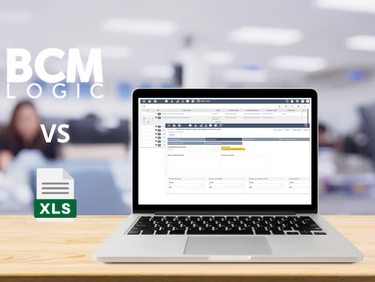
Want to see the platform’s advantage over Excel in action? Book a dedicated demo of our solution today.