For years, DataTech Solutions, a small IT company, provided reliable services to medium-sized businesses, offering IT support and delivering custom workflow and credit process solutions. However, a prestigious new contract with FinBank opened up exciting opportunities—along with significant new challenges.
FinBank sent DataTech an official request demanding the results of a risk analysis, a business continuity plan, and an information security policy. The bank explained that under the DORA (Digital Operational Resilience Act) regulation, any company providing ICT services to financial institutions must meet strict digital operational resilience standards.
What is DORA?
The Digital Operational Resilience Act (DORA) is an EU regulation designed to ensure that financial institutions and their ICT providers can withstand cyberattacks, system failures, and other digital threats. It regulates operational risk management in the financial sector and introduces mandatory vetting for technology vendors. This means that every ICT service provider, like DataTech Solutions, must document its risk management approach and demonstrate robust security mechanisms to ensure digital resilience.
Digital operational resilience is a company’s ability to maintain continuous operations in the face of digital disruptions, such as cyberattacks, system failures, or other technological threats. It encompasses not only rapid disaster recovery but also proactive incident prevention and the maintenance of high information security standards.
The Challenge
For DataTech Solutions, this was completely uncharted territory. They had never been required to provide this level of documentation before, and their small team lacked the in-house experts and tools needed to prepare a comprehensive risk analysis or business continuity plan. They considered hiring an external consultant, but the costs were prohibitively high. Scouring the internet, they found document templates, but these were far too generic and failed to reflect the specific nature of their business or the technologies they used. With FinBank demanding the documentation on a tight deadline, the pressure was mounting.
The Solution
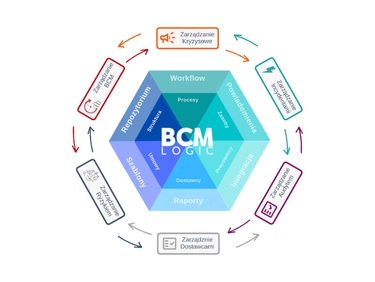
That’s when Ewa, DataTech’s manager, discovered the BCMLogic One platform. While trusted by large enterprises, it was also available in a specialized SaaS edition tailored for small and medium-sized businesses just like hers. BCMLogic One provided a comprehensive suite of tools for identifying, analyzing, and managing risks across cybersecurity, business continuity, data security, and vendor risk. Furthermore, the platform featured a proprietary AI solution that supported users at every step—from risk identification to generating perfectly tailored documents and policies.
Ewa decided to test BCMLogic One. Right from the start, the platform proved incredibly intuitive. The tool guided her step-by-step through the risk identification and mitigation process, taking into account DataTech’s specific business profile and technology stack. Thanks to advanced AI, the system recommended best practices and solutions, automatically adapting templates to the company’s precise needs.
Within just a few days, Ewa and her team were able to create a complete risk analysis, a business continuity plan, and an information security policy—documents that fully satisfied DORA requirements. At the same time, the company was able to map its security profile against recognized industry standards.
BCMLogic One helped DataTech Solutions not only meet FinBank’s strict requirements but also strengthen the company’s internal digital resilience. The platform became an invaluable risk and security management tool, enabling the company to operate in compliance with new regulations and prepare for future challenges.
Thanks to BCMLogic One, DataTech Solutions saved significant time and money by avoiding expensive consultants. More importantly, they gained the confidence that they are fully prepared to meet market demands, even in the face of escalating regulatory requirements.